
Memetics Pt. 4: Short Towers + Secret Gnosis
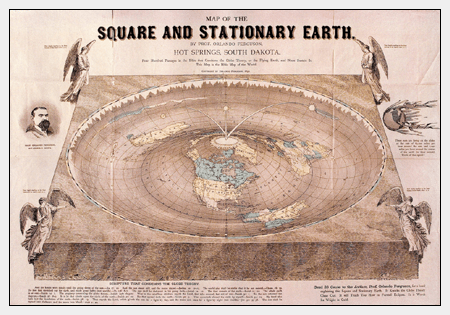
In the first two videos on memetics (see schedule below), we talked about how truth — and other things we like — may not be decisive when it comes to the “spreadiness” and “stickiness” of certain ideas. In other words, “goodness” does not necessarily yield “fitness.”
In the third video, we talked about how some of the neuropsychological patterns that drive our decisionmaking can prompt and prevent virulence and resilience (“spreadiness” and “stickiness”). In that video, we focused primarily on loss aversion.
In this video, we’re going to talk about another such pattern, called secret gnosis stimulation.

We’ll find out why having and enjoying “hidden knowledge” can make you feel privileged, validated, and “rooted” to your local “tower,” even if it’s not tallest. This “hidden knowledge” often takes the form of esoteric or counterintuitive claims that can be convincing when internally consistent, and/or without a competitor recognized as viable.
We’ll also discuss several specific case examples of groups of people who are rooted to false conspiracy theories. Controversial!
Secret gnosis stimulation is very effective here, too. … It gets you locked into conspiracy theories when the body of [apparent evidence for the conspiracy] is dwarfed by reality.
Schedule
- Memetics Pt. 1: Introduction, and the “Fitness” Snag
- Memetics Pt. 2: The Four Brothers (and Their Business Booths)
- Memetics Pt. 3: The Short Tower Problem
- Memetics Pt. 4: Short Towers + Secret Gnosis

Kicking Baal Out of Schools
You live in the United States. In the Constitution, it says that congress can make no law respecting an establishment of religion or prohibiting the free exercise thereof.
One of the founding fathers, Thomas Jefferson, described this amendment as a “wall of separation between the church and the state.”
You go to a state-run public school, which must conform to this Constitutional maxim.
First Day of School
It’s your first day at this school, having arrived in a new town after moving.
You get on the bus and are driven to school. The bus parks, but the door hasn’t opened yet. The bus driver is sitting there, silent.
A student in the very front stands up. She is wearing a strange conical hat.
“All who worship Baal Hadad as master and lord, raise your hand in reverence!” she shouts. All of the other children raise their hands and look around.
Several notice that you’re not raising your hand, and begin to whisper and murmur to one another. Soon, everyone is talking about you, and looking at you like something is completely wrong with you.
You really want to leave. Why isn’t the bus driver opening the door? You stand up and walk hurriedly down the aisle.
“Let me off,” you shout at the bus driver.
“Of course, you’re not captive,” says the driver, and opens the door for you.
But Soon…
You go to your first class. The bell rings for class to start, but the teacher is sitting silently at her desk, reading.
Like on the bus before, a student up front, wearing a conical hat, stands up and addresses the students.
“Let us now sing praises to Baal Hadad, king of the heavens!” he shouts.
He begins to sing. The other students join him. You don’t want to be a part of this.
You get up to walk to the teacher, who is still reading silently. As you do, the other students stop singing, and stare, aghast that you would interrupt the worship. They give you horrible looks and scoff.
You ask the teacher to be excused.
“Of course,” the teacher says, and gives you a pass to read in the library until the lesson begins.
You come back 10 minutes later, and the teacher has already started teaching. You rush to take your seat.
This happens in several subsequent classes. Sometimes singing, sometimes a creed recital, sometimes a prayer, sometimes a “meditative moment of silence.”
Similar things happen at lunch.
You go to an assembly. Same thing.
Each time, no school faculty is directly involved. They just sit silently while the students lead the Baal-worship. And each time, when you ask to be excused, you’re allowed.
Legal Action
This is a horrible state of affairs that clearly violates that “wall of separation” of which the Jefferson wrote. This town of Baal-worshipers is transparently and cynically incorporating Baal-worship into their public school system by using a “back door” of “periods of inactivity” + “student-prompted actions.”
You decide to hire a lawyer and try to put a stop to this.
The resolution is that if public school faculty has reasonable knowledge that a student plans to perform religious rituals for reasons other than pure, curricula-driven education, they have to stop it. Otherwise, they are giving official permission, even if it’s veiled under the auspices of “faculty passivity” and “student freedom.”
The Supreme Court hands down this decision.
To violate this decision is to violate the Constitution.
The Social Aftermath
The incorporation of prayers and worship and creeds to Baal disappears at your school.
Now, instead of getting dirty looks from students for asking to be excused, you get dirty looks from students and their parents.
They blame you for “kicking Baal out of schools” and falsely complain that the school has “banned prayer.”
Conclusion
State-run institutions should not be complicit in the worship of deities, because not everyone believes in those deities.
As Christians, we should be passionate about making sure that everyone is treated with charity and equity, and not attempt to force our beliefs on others through state-run institutions.
Prideful shows of allegiance, intimidating social pressure, and ostracism do nothing but sow resentment and discomfort in non-believers. This is trivially obvious when you craft an imaginary situation in which you’re in “their shoes.”

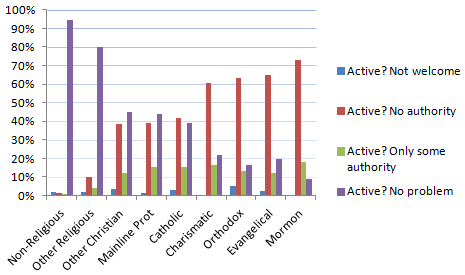
Survey of Reddit’s Christian Community on Homosexuality

I surveyed the Reddit community /r/Christianity on the topic of homosexuality. /r/Christianity contains mostly Christians, but also people of all faiths (and lacks thereof). It has nearly 80,000 subscribers at the time of this post.
Here are the results.
- The survey received 2704 responses.
- It’s not a random sample, not scientific, etc.
- Responses with duplicate IPs after the first instance were deleted. There were 16 such submissions.
- Most concerned about apparent bias in the verbiage thought I personally leaned anti-gay, which is incorrect. I did not respond myself, but my responses would have been: B, C, C, D, B, B, A, A, United States, G.
- My paraphrasing used in the graphs, for brevity, do not 100% sync up with the question responses. Be familiar with the questions/answers before you skip to the graphs.
The first section lists all of the questions, the criticisms I received and, upon retrospect, gave myself, as well as the one-dimensional data.
The second section contains a list of cross-referenced responses I thought were interesting.
Question 1
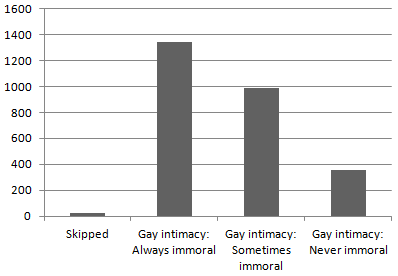
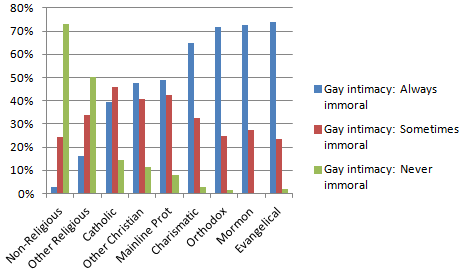
1. What best describes your opinion on the propriety of homosexual intimacy?
- It is always sinful and/or immoral.
- Like with heterosexual intimacy, there are contexts in which it is — and contexts in which it is not — sinful and/or immoral.
- There is no context in which consensual sexual intimacy is ever sinful or immoral.
Criticisms:
- Many wanted more granular options as to the things that could make it immoral. For example, a person might believe adultery is immoral but promiscuity is not.
Question 2
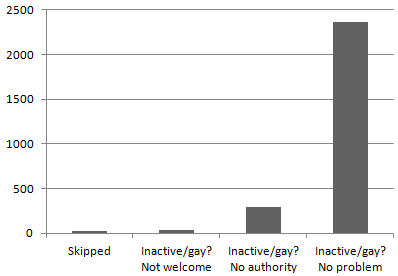
2. What best describes your attitude about non-active (that is, not having sex) homosexuals in the church?
- Non-active homosexuals should not be welcome in the church at all.
- Non-active homosexuals should not hold any office of authority.
- There should not be any sort of special prohibition given to non-active homosexuals.
Criticisms:
- Later, question #4 has both “any offices of authority” and “some offices of authority,” but that isn’t broken-out here.
- Also, a person might answer the second option while believing the issue is (a) can’t marry, plus (b) lack of married qualification. This person might want a specific option for them.
- Finally, “welcome in the church” is ambiguous; it could mean welcome in service, or welcome for membership.
Question 33. What best describes your attitude about active (that is, having sex) homosexuality in the church?
- Active homosexuals should not be welcome in the church at all.
- Active homosexuals should be welcome in the church, but must be actively urged to stop their homosexual intimacy.
- Active homosexuals should be welcome in the church without any special risk of indictment.
Criticisms:
- Many wanted more granularity on “actively urged.”
- Also, “welcome in the church” is ambiguous; it could mean welcome in service, or welcome for membership.
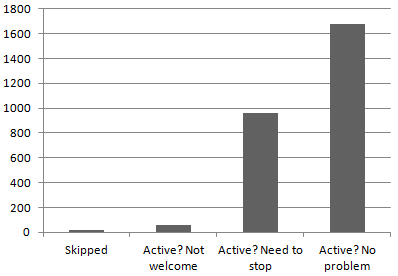
Question 4
4. What best describes your attitude about active (that is, having sex) homosexuals seeking offices of authority in the church?
- As I said above, active homosexuals should not be welcome in the church at all.
- Active homosexuals should be welcome in the church, but should not be able to pursue any office of authority.
- Active homosexuals should be welcome in the church, and should be able to seek some offices of authority, but not others.
- There should not be any sort of special prohibition given to active homosexuals in the church.
Criticisms:
- Many wanted more granularity on “offices of authority.”
- Also, “welcome in the church” is ambiguous; it could mean welcome in service, or welcome for membership.
- Finally, “welcome in the church” is ambiguous; it could mean welcome in service, or welcome for membership.
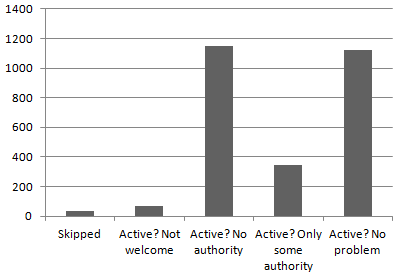
Question 5
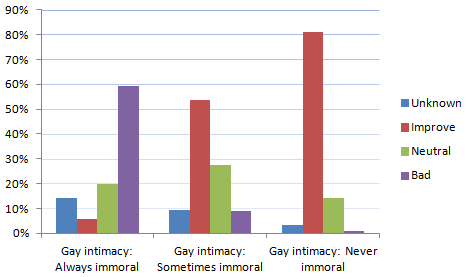
5. Do you think popular acceptance of gay marriage will affect society negatively?
- Who knows?
- I think it will improve society, actually.
- Probably not.
- Maybe just a tiny bit.
- I think it will affect it negatively somewhat.
- I think it will have a major negative impact on society.
- I think it will ruin society.
Criticisms:
- Some wanted an option for “the government should not recognize any marriage.”
- Some wanted the “certainty” on an orthogonal gradient.
- Some wanted to clarify the negative impact as being a product of sin in general.
- Some wanted more granularity on the “improve” end.
- Some inferred unintended overtones from the use of the word “Actually,” when it was meant simply to unload the question; it should have been reworded.
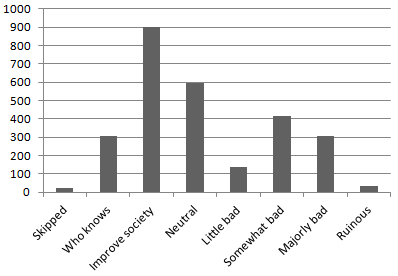
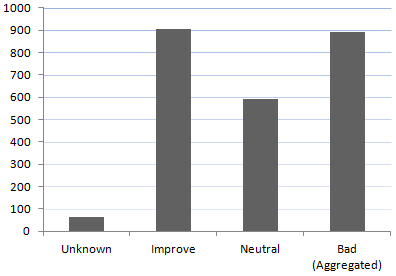
Question 6
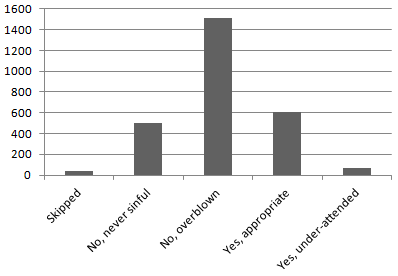
6. Do you think that the negative attention given — by the church in general — to active (that is, having sex) homosexuality is warranted?
- No; active homosexuality is never sinful or immoral, so it should not receive negative attention at all.
- No; there are many bigger fish to fry.
- Yes; it has received its fair warrant of attention.
- Yes, but it should be even more of a focus.
Criticisms:
- The second option should have been worded in such a way that active homosexuality not be presumed to be a “fish to fry” at all.
Question 7
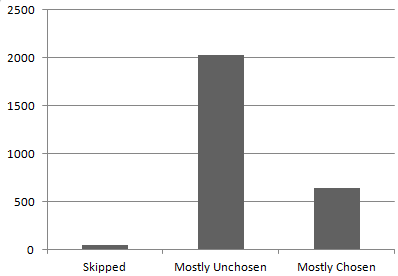
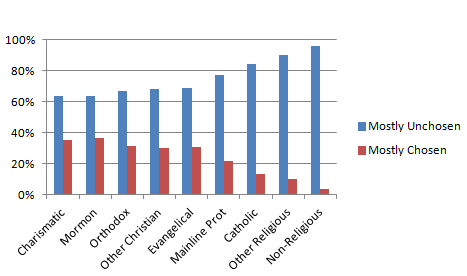
7. Do you think that being homosexual (that is, the orientation or preference) is a choice?
- No, or mostly no. Formative factors (whatever they might be) most likely dictate a person’s sexual orientation to a nearly-irresistible degree.
- Yes, or mostly yes. A person can elect to sexually prefer those of the opposite sex, even if it takes some effort.
Criticisms:
- The explication was too bifurcating. This question assuredly deserved more granularity, especially because many believed that it is a choice for some, and not for others.
Question 8
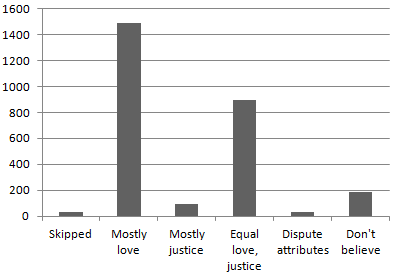
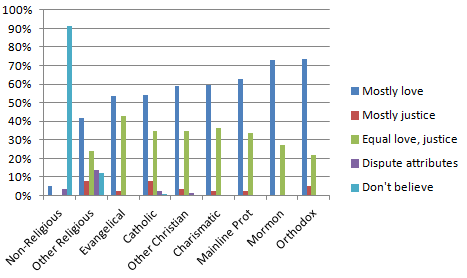
8. Of the following two attributes typically given to God, which do you most try to emulate in your life?
- His merciful love.
- His discerning justice.
- I try to emulate both equally.
- I don’t believe God has these attributes.
- I don’t believe in God.
Criticisms:
- Some disputed the notion that mercy and justice cannot be expressed simultaneously, which is a notion I held as survey author.
Question 9
9. What country are you from?
- 87 Skipped
- 2072 USA
- 190 Canada
- 102 Australia
- 100 UK
- 23 New Zealand
- 15 Netherlands
- 11 Germany
- 11 Sweden
- 9 Ireland
- 6 Denmark, Philippines, Singapore
- 5 India, Indonesia
- 4 Brazil, Norway, Poland
- 3 Czech Republic, France, Russia
- 2 Finland, Mexico, Puerto Rico, South Africa, South Korea, Zimbabwe
- 1 Argentina, Austria, Bahamas, Bulgaria, China, Colombia, Ecuador, Egypt, Estonia, Faroe Islands, Ghana, Iran, Italy, Lebanon, Liberia, Nigeria, Portugal, Romania, Slovakia, Sri Lanka, Ukraine, Venezuela, Vietnam, Zambia
Question 10
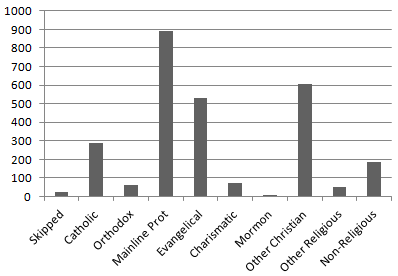
10. Which of the following best describes the cohort to which you most belong?
- Catholics
- Orthodox
- Mainline Protestants (an American term that lumps together “older” denominations like Lutherans, Methodists, Episcopalians, Presbyterians, etc.)
- Evangelicals
- Charismatics
- Mormons
- Christians that cannot be considered part of the above 6 cohorts
- Religious or spiritual people, but non-Christian
- Non-religious and non-spiritual people
Interesting Cross-Referenced Responses
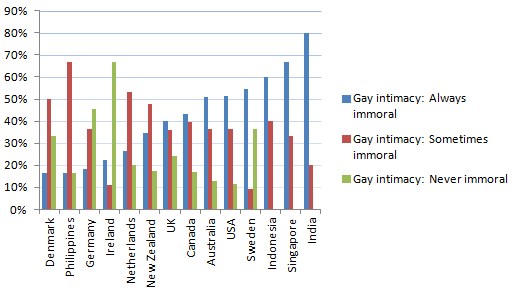
Percentage “Country, >4 responses” against “Morality/immorality of gay intimacy.”
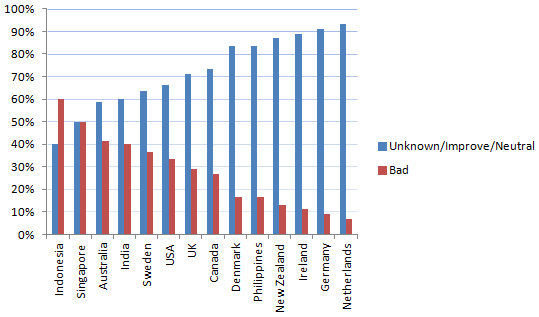
Percentage “Country, >4 responses” against “Social effect of gay marriage acceptance, clamped to ‘Unknown/Neutral/Improve’ vs. ‘Bad.'”
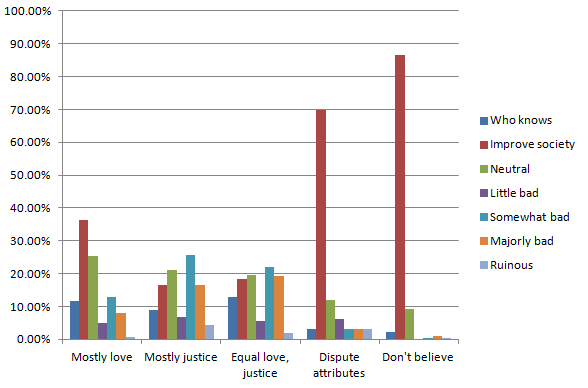
Percentage “Emulating God’s attributes” against “Negative social effect of gay marriage acceptance.”
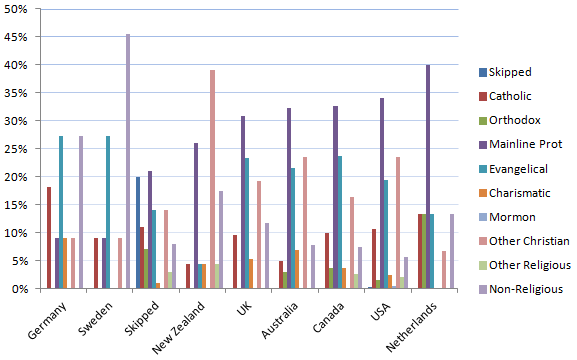
Percentage “Countries, top 8 + skipped” against “Subscriptive cohort.”
Percentage “Countries, top 4,” against “Subscriptive cohort.”
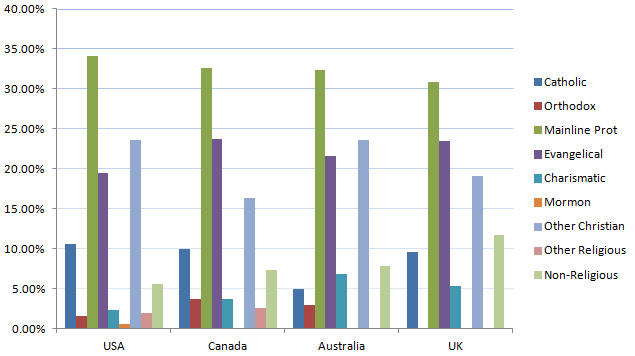
Percentage “Subscriptive cohort” against “Countries, top 4,” inverted.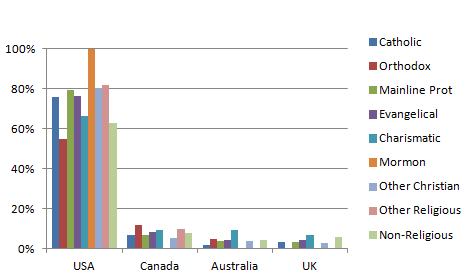
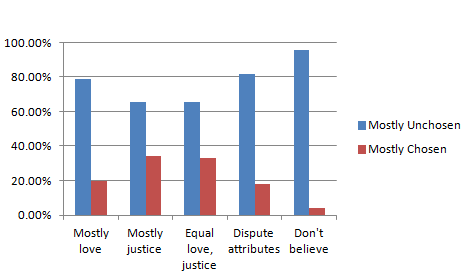
Percentage “Emulating God’s attributes” against “Homosexuality chosen?”
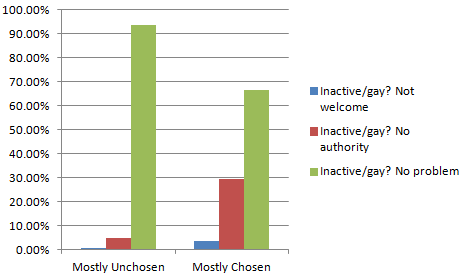
Percentage “Homosexuality chosen?” against “Response to inactive homosexuals in church.”
Percentage “Subscriptive cohort” against “Emulating God’s attributes.”
Percentage “Subscriptive cohort” against “Homosexuality chosen?”
Percentage “Subscriptive cohort” against “Morality of gay intimacy.”
Percentage “Morality of gay intimacy” against “Effect of acceptance of gay marriage on society, ‘bad effects’ clamped.”
Percentage “Subscriptive cohort” against “Church response to active homosexuals.”
Memetics Pt. 3: The Short Tower Problem

In the last two videos on memetics (see schedule below), we talked about how truth — and other things we like — may not be decisive when it comes to the “spreadiness” and “stickiness” of certain ideas. In other words, “goodness” does not necessarily yield “fitness.”
But that’s not the whole picture. Vital to memetics is an understanding of how neuropsychological patterns can prompt and prevent virulence and resilience (“spreadiness” and “stickiness”).
Today, we’re going to talk about one of the most important patterns to understand — loss aversion — and how it impacts memetics.
We’ve already talked about loss aversion twice on this site:
- In “Bibliopsychology: Why the Servant Did Nothing,” we talked about the reluctance to commit our charity, a failing against which we must fight.
- In “Up a Tree,” we talked about a good way to think about loss aversive rooting behavior. Today’s video will echo some of these themes.
Its impact on memetics is manifold, and I think you’ll enjoy how the breakdown plays out through the story of the tower seeker.
(For those familiar with genetic algorithms, this is “local maxima” in function.)
Get out there and really investigate. I can’t believe this guy when he says, “I’m an authority,” “I’m Dr. Tower (even if he is Dr. Tower),” “They have a conspiracy”… These things might all be the case, but you are the final gatekeeper to the keep of what you believe.
Schedule
- Memetics Pt. 1: Introduction, and the “Fitness” Snag
- Memetics Pt. 2: The Four Brothers (and Their Business Booths)
- Memetics Pt. 3: The Short Tower Problem
- Memetics Pt. 4: Short Towers + Secret Gnosis
Is God the Author of Evil? (Semantics of “Want/Will”)

God’s superordinate responsibility for absolutely everything that happens follows directly from his classical attributes:
- God is omnipotent (having complete authority over creation to heal, stop, or functionally undo anything he pleases).
– - God is omniscient (even if only about the present).
– - God has a will (he isn’t indifferent or inactive).
– - God has at least an occasional willingness to intervene in the affairs of mankind to direct or course-correct.
If those properties are accepted, there’s no coherently-expressible way to avoid that conclusion of complete superordinate responsibility.
The Tension
But we don’t want to say that God is the author of evil, nor do we want to say that he meticulously micro-manages trivial events, like the precise manner in which a certain leaf is tossed-about by the wind.
Put another way, we hope to avoid saying that God deliberately “wanted”:
- Trivial things that have no significance.
- Horrible things that could have, theoretically, been miraculously averted.
Quietude to the Yawn-Inducing Rescue
The goal of theological Quietude is to remedy doctrinal disputes by identifying boring language problems responsible for the perpetuation of those disputes.
Whereas exciting, passionate, Loud theology would have us say, “There’s got to be more to it,” theological Quietude says, “That’s actually all there is to it.”
Quietude solves our problem.
First, Quietude asks the following (Quietude often asks clarifying questions):
What Does “Want” Even Mean?
As it turns out, the word “want” is horribly confusing, and nobody knows precisely what it means without additional inference or explication.
“Now hold on there, Stan,” you might be thinking. “‘Want’ is one of the first words we learn as children. It’s 4 letters. It’s a single syllable. It seems pretty dang straightforward!”
But It Isn’t
Here are five completely theologically distinct definitions of “want.”
Sense #1: “What you want” is any one of many desires within you.
 Often you’ll have multiple desires, some of which may be incommensurable.
For example, you can really want to make your wife happy by coming home on time, and you can also really want to make your boss happy by staying at work late.
Sense #2: “What you want” is the desire that “wins” and is ultimately expressed.
 If you choose to make your boss happy by staying at work late, then this is what you “wanted” in this Sense #2.
Sense #3: “What you want” refers to your higher-order desires only.
You may have the lower-order desire to give in to temptation and eat the sundae, but you have the higher-order desire to abstain in service of your diet. Abstaining is “what you want,” independent of which choice you ended up making.
This Sense #3 is the one used by Paul in Romans 7:15.
 Sense #4: “What you want” refers to your lower-order desires only.
 Giving in to temptation is truly “what you want,” even if you end up abstaining.
Can you see how crazy this is getting, yet? Senses #3 and #4 are complete opposites.
Sense #5: “What you want” refers to your grossly selfish desires only.
 This is similar to Sense #4; interest “orders” are fuzzy, but others-focus is often considered “higher.” In this sense, running away when you should make a sacrifice is “what you want.”
(The “you” is often emphasized here; there is an implied “for yourself” trailing subclause.)
The Sixth “Want”
But there is a Sense #6 as well. It’s very similar to Sense #2 (the desire that “wins”), with one key difference: It’s where no desire “wins,” but rather, the desire set is just “best-expressed,” and in a way that doesn’t fully satisfy any of them.
This can happen when two or more of those desires are incommensurable.
Let’s take the “come home / work late” scenario. In it, I could stay just 45 minutes late. I’d make my boss a little happy and a little disappointed, and my wife a little happy and a little disappointed.
I wouldn’t be perfectly expressing my desires, but I’d be optimally expressing my desires.
And, for the first time, the gold star of “want” is not placed on any of my driving desires, but rather the expression thereof:

A Perfecting Plan
Often, the incommensurability of desires is circumstantial. For example, if my wife is going to be at a school function late anyway, then I don’t need to come home on time in order to keep her happy.
If I find myself in a Sense #6 situation, I’ll want circumstances to change over time such that my optimal expression doesn’t seem so suboptimal anymore.
The best plan would be one which transforms mere optimization into perfection:

This would be a plan of “birthing pains,” to invoke Romans 8. Creation wasn’t finished at the Garden, to invoke Irenaeus.
God’s Will
These variants of “want” can be similarly applied to “will.”
Pretending as if the definition of “God’s will” is single-faced, instead of many-faced as shown above, causes all manner of meaningless discussion and fruitless contemplation.
Let’s journey through each of the senses and compare them against our classically sovereign God.
- In Sense #1 (competing, inner wants), it is not God’s will that evil exist.
– - In Sense #2 (the inner want that wins), it is not God’s will that evil exist.
– - In Sense #3 (the higher-order wants), it is not God’s will that evil exist.
– - In Sense #4 (the lower-order wants), God wants for nothing; he is not like humans, who are pitifully ignorant and have volatile desire sets.
– - In Sense #5 (the grossly-selfish wants), God wants for nothing; he is loving.
But in Sense #6 (the optimal expression of the total desire set, with temporary dissatisfaction), God did indeed will that evil exist.
But only in this limited, 6th Sense.
And this is indeed what we find in Scripture. For although God is benevolent and loving, he is superordinately responsible for the “bad stuff” — Heb. raah.
I form the light, and create darkness: I make peace, and create evil (Heb. raah): I the Lord do all these things.
Shall a trumpet be blown in the city, and the people not be afraid? shall there be evil (Heb. raah) in a city, and the Lord has not done it?
Do not both evil (Heb. ha-ra-owt) and good come from the mouth of the Most High?
So, Is God the Author of Evil?
The answer is “No… that is, depending on what you mean by ‘author.'”
In the superordinate sense in which I say that “God owns my house,” he is. And, as we saw above, that’s also what the Bible says.
But that’s not what we usually mean when we talk about the authoring evil.
Usually, when we talk about authoring evil, we mean orchestrating events with consequentially ill intent — malice, destructive hedonism, gambling with lives, etc.
Willing “bad stuff” in one of the first 5 Senses, in other words.
In those senses, we would certainly not say that God is the author of evil, and these are the senses to which the early theologians are so averse.
If Natural Development is Valued…
If one of God’s desires is to stay mostly hands-off, letting nature take its course with minimal course-correcting intervention, then as part of that “perfecting plan,” we’ll plausibly see all sorts of “bad stuff” and “trivial stuff” — even such stuff with no prospective purpose except to satisfy that mostly-hands-off desire.
This conjecture would fit with the pattern we see in the Bible, where God intervenes directly and publicly only a few dozen times over millennia — where, for most, “He who is unseen” must be sought and found.
Of course, with the “bad stuff,” we hold a sacred hope that God’s genius and foreplanning would somehow use it for goodness, down the road, despite itself.
But this prospective utility is not assured for every “bad thing.” Natural protrusions of triviality and evil alone may satisfy a desire to “mostly let run,” if only that humanity look itself in the mirror. We dare not contrive theodicean prophecy in a misguided attempt to solve the experiential problem of evil. That’s completely above our paygrade.
To hope, however, is officially in our job description.
Appellate Prayer, Sovereignty, and Superstition

For us Christians who believe in absolute sovereignty in the classical sense — that is, a God with an optimal predetermined plan for everything — we see appellate prayer not as a way to derail God’s plan of action, but to express ourselves and establish a conduit by which a communicative connection can be made between ourselves and God.
1 John 5:14
“And this is the confidence that we have toward him, that if we ask anything according to his will he hears us.”
That is, when we pray for something in service of his will, and that thing comes to pass in startlingly, apparently significant ways, it’s not as if we think those prayers surprised or jarred God into action.
With All of Our Hearts
We who reject such a “surprising God” paradigm say instead that, by praying for something, we engage in two important Graces.
First, we’re given a release to express our tensile poverties and weaknesses.
Philippians 4:5b-7
“The Lord is near. Do not be anxious about anything, but in every situation, by prayer and petition, with thanksgiving, present your requests to God. And the peace of God, which transcends all understanding, will guard your hearts and your minds in Christ Jesus.”
Second, we’re establishing a “flagpost A,” and when the thing comes to pass as “flagpost B,” we ostensibly have communicative evidence and, as such, appellate prayer is a vital “faith-helper.”
Jeremiah 20:13, 33:3
“[To the exiles in Babylon:] You will seek me and find me when you seek me with all your heart. … Call to me and I will answer you, and will tell you great and hidden things that you have not known.”
1 Chronicles 16:11
“Look to the Lord and his strength; seek his face always.”
That’s what it means to say that God answers prayer, even while being completely sovereign (in the classical sense) and non-contingent. This is also why we echo Christ and say in our hearts to the Father, after every appeal, “Yet not my will, but yours be done.”
We temper and humble ourselves also because we know that we’re really bad at asking for what we really need.
Sometimes this is due to selfishness, but other times it’s merely due to our woefully volatile and corrupt interest sets, combined with our pathetic faculties of discernment and foresight.
James 4:3,8a
“You ask and do not receive, because you ask wrongly, to spend it on your passions… Come near to God and he will come near to you.”
As a result, “Flagpost B,” is very often completely unexpected, very often shrewdly timed, and very often startlingly profound, because the Spirit transforms our subpar vocalizations into secret prayers that conform to the Father’s sovereign will.
Romans 8:26-27
“Likewise the Spirit helps us in our weakness. For we do not know what to pray for as we ought, but the Spirit himself intercedes for us with groanings too deep for words. And he who searches our hearts knows the mind of the Spirit, because the Spirit intercedes for God’s people in accordance with the will of God.”
With All of Our Minds
At the same time, if we’re to have the kind of faith that is reasonable, we have to be self-critical and temper our faith with careful scrutiny.
It’s all-too-easy to go from what we Christians consider healthy faith into destructive superstition, over-attributing every little thing to miraculous divine intervention. You’ve seen this happen when reckless Christians claim God’s miraculous stamp of approval for every decision they make, and when certain Christians, like modern-day Dr. Panglosses, arrogantly and sinfully make false prophesies about the specific reasons for natural disasters and the like.
We have all sorts of skeptic’s considerations to keep our judgments prudently humble which we must diligently employ.
- Littlewood’s Law. Given enough time, weird stuff is bound to happen naturally and without discernible purpose. (Be careful with this one; “enough” is an ungrounded antecedent.)
- Confirmation bias. We tend to recklessly rush to conclusions when we’d prefer them to be true.
- Placebo. Thoughts and attitudes can have recursive psychological and physiological effects on ourselves. This isn’t inherently bad or good; there are healthy and unhealthy ways that this can affect us.
That said, there may come a threshold, in an individual’s experience, after this healthy scrutiny, at which it can be reasonable to conclude “God.”
Counterintuitively, this can be reasonable even if God doesn’t exist or doesn’t answer prayer. Reason (in the Kantian sense) proceeds from fully-considered experience tempered by fully-employed logic, and is not synonymous with “truth,” because an appeal is made to an individual’s corrupt faculties of observation and contemplation.
At the same time, we’re not Solipsists in practice, and so we come to conclusions given imperfect evidence. We do our best prep, then make our best guess. Relentless skepticism is not a religion, but relentless skepticism risks an opportunity cost, just like any religion.
Between Heart and Mind
Prayer is our tether to an interactive God, who is nonetheless “He Who Is Unseen.” It’s a prerequisite for reasonable faith, essential for genuine humility, and a conduit to unload our anxieties to he who is in complete control of the global situation.
But his activity is subtle and shrewd, and the wisdom underpinning it — beyond human understanding or dissection — warrants humble, diligent seeking and sifting, and not reckless prophesying.
When Should We Legislate Morality?

Is it good to push what we consider “Biblical morals” into law?
The answer is often “no,” for two very important reasons:
Reason 1
When church and state are mixed, the church is corrupted by the state, and the state is corrupted by this new church.
Reason 2
“My small church disagrees with your mega-church.”
Koinodoxy is not orthodoxy; what is popular is not always right, and what is right is not always popular.
A Heuristic for Moral Legislation
It’s fine to legislate morality under the following set of conditions only:
- Without the law, things are (or would be) gravely harmful in terms of values near-universal to people.
– - This harm is demonstrable (we can’t just declare the harm).
– - The law would be demonstrably effective at fixing this problem (we can’t just assume the fix will work).
– - The “costs” of the law and its byproducts would not outweigh its “benefits.”
It goes without saying that many Biblical proclamations would not qualify under the above conditions. Many come down to issues of discipline or scruple. Many are rooted in a bygone culture, like where braided hair was considered immodest. And many are explicitly meant only for the church.
This is why:
- We don’t make laws against lying except under grave and demonstrable circumstances.
- We don’t make laws against getting angry except under grave and demonstrable circumstances.
- We don’t make laws against coveting, gossip, etc.
… even though the Bible clearly generally frowns upon lying, anger, coveting, and gossip.
Something in the world may irritate you or violate a tenet of moral propriety to which you hold. But if your first thought is, “There oughtta be a law!,” it may be a symptom of hasty prohibitionism.
Prohibitionism from Simple Thought
Many do not realize that “Is X morally wrong?” and “Should there be a law against X?” are two completely different questions.
Prohibitionism from Memetically Strong Fictions
In the heuristic above, you may have noticed that demonstrability is required at several stages. This is necessary to maintain a “sandbag wall” of careful criticism to defend ourselves against urban myths, “common sense” nonsense, and various other memetically strong fictions.
For example, did you know that in the late 19th century, American public schoolchildren — particularly in the culturally “drier” states — were taught that drinking alcohol could cause spontaneous combustion?
However ludicrous this was, memetic fiction can have a life of its own if left unchecked. Over-demonizing was one of the many factors that helped catalyze the later nationwide prohibition, which is now universally regarded as a complete disaster.
Prohibitionism from Tribal Pride
The attempt to inject religious prescriptions into state law without qualifying under the above conditions comes often from pride.
Consider pride in a hometown football team. If I love the Spearmen, I might put a “Go Spearmen!” banner in my window.
But as soon as I spraypaint “Go Spearmen!” on my neighbor’s house, I am a vandal, which is a certain brand of property thief.

It doesn’t matter if I feel great pride in my Spearmen. I may say, “I feel that spraypainting my neighbor’s house would be standing up for my team, and expressing my support for the Spearmen.”
Unless I can demonstrate a grave harm in universal terms that would be fixed by my vandalism and that it would lack significant side-effects, my vandalism cannot be justified.
Memetics Pt. 2: The Four Brothers (and Their Business Booths)

In the first of our four-part series on memetics, we talked about how the virulence (“spread-iness”) and resilience (“stickiness”) of ideas determines the flourishing of those ideas, even if those ideas are bad in terms of things we call “goodness,” like truth, justice, and quality of life.
This has the counterintuitive result of labeling really bad things as “fit.”
Today, we’re going to apply this to a thought experiment in which four brothers try to make their businesses successful through four different strategies.
First, we’ll meet Reilly, Murtagh, Shane, and Lochlan.

Later in the video, we’ll also be introduced to a fifth (bonus!) brother, Gerrard, and see what strategy he employs, and how it works out for him.
The illustration of the brethren and their booths will demonstrate how:
… memetic action — resilience and virulence — is what matters [for flourishing]. Truth kinda goes by the wayside. Making sense can kinda go by the wayside. And if you and I care about truth and making sense — which I’m sure we do — then we’ve gotta watch out…
Schedule
- Memetics Pt. 1: Introduction, and the “Fitness” Snag
- Memetics Pt. 2: The Four Brothers (and Their Business Booths)
- Memetics Pt. 3: The Short Tower Problem
- Memetics Pt. 4: Short Towers + Secret Gnosis
Christus Victor: Existentialism Faces Eternity

Last week, we talked about how meaning is not objective. Every appeal for a rational justification of meaning in turn requires its own appeal.
This is the “infinite reference problem,” and pursuing it in search of some ultimate and rational end-point is a “chasing after the wind.”

We’re given this lesson from Ecclesiastes.
But, for us Christians, the future is not bleak. We have a unique solution, thanks to Jesus Christ.
It doesn’t solve the infinite reference problem, but it creates a practical meaning-fountain that annihilates the “existential monster.”
Everything is Meaningless
First, it’s vital to understand the extremely uncomfortable lesson given to us by Ecclesiastes.
In Ecclesiastes, the assumption is that when a man dies, he’s dead, and that’s it. You go to the grave. Your dust goes into the ground, your breath goes back to God. You’re finished.
Ecclesiastes 3:18-22
“I also said to myself, ‘As for humans, God tests them so that they may see that they are like the animals. Surely the fate of human beings is like that of the animals; the same fate awaits them both: As one dies, so dies the other. All have the same spirit/breath; humans have no advantage over animals. Everything is meaningless. All go to the same place; all come from dust, and to dust all return. Who knows if the human spirit/breath rises upward and if the spirit/breath of the animal goes down into the earth?’
So I saw that there is nothing better for a person than to enjoy their work, because that is their lot. For who can bring them to see what will happen after them?”
His early conclusion is to “just stop” on the axial value of enjoying your toil and lot.
Ecclesiastes 4:18
“This is what I have observed to be good: that it is appropriate for a person to eat, to drink and to find satisfaction in their toilsome labor under the sun during the few days of life God has given them — for this is their lot.”
The essential premise of Ecclesiastes is that we’re not going to be around after we die.
Leaving a legacy still leaves uncertainty.
- Our bequests?
- Our treatises?
- Our progeny?
We cannot be certain in any of it.
Ecclesiastes 6:12
“For who knows what is good for a person in life, during the few and meaningless days they pass through like a shadow? Who can tell them what will happen under the sun after they are gone?”
Thus, the “just stop” existential conclusion:
Ecclesiastes 9:9-10
“Enjoy life with your wife, whom you love, all the days of this meaningless life that God has given you under the sun — all your meaningless days. For this is your lot in life and in your toilsome labor under the sun. Whatever your hand finds to do, do it with all your might, for in the realm of the dead, where you are going, there is neither working nor planning nor knowledge nor wisdom.”
Additionally, investments (though uncertain) are lauded (11:1-6), and obedience to God is demanded (11:7-10) because it’s our duty, and because we’ll risk his judgment — in life.
Many mainstream Christian teachers would like Ecclesiastes not to exist, or to say something other than what it does.
They’d prefer that it conclude with a rejection of “everything is meaningless,” as if teeing up a ball earlier only to finally smash it out of the park.
But that’s not what happens.
Ecclesiastes 12:6-10
“Remember [the Creator], before the silver cord is severed, and the golden bowl is broken; before the pitcher is shattered at the spring, and the wheel broken at the well, and the dust returns to the ground it came from, and the spirit/breath returns to God who gave it.
‘Meaningless! Meaningless!’ says the Teacher. ‘Everything is meaningless!’ Not only was the Teacher wise, but he also imparted knowledge to the people. He pondered and searched out and set in order many proverbs. The Teacher searched to find just the right words, and what he wrote was upright and true.”
Meaning Generators
Even though everything is ultimately meaningless, we still create meaning since we’re beings with innate and/or molded interests. Each one of us is a “meaning fountain” — as is God himself.
It’s not about what simply is meaningful in a vacuum. It’s about what is regarded meaningful, according to the interests of beings with interests.
The writer of Ecclesiastes recognized that we generate meaning in this way through the provisions of life that we enjoy. We find meaning in food, drink, our projects, our families, our investments, and our thankful obligation to our Creator.
But, for us, that “generation” dies. In the end, we all go kaput.
That’s the sad and bleak part of all of this.
Then Comes Christus Victor
Paul tells us that man’s physical death is a consequence of his having sinned:
Romans 5:12-14
“Therefore, just as sin entered the world through one man, and death through sin, and in this way death came to all people, because all sinned. To be sure, sin was in the world before the law was given, but sin is not charged against anyone’s account where there is no law. Nevertheless, death reigned from the time of Adam to the time of Moses, even over those who did not sin by breaking a command, as did Adam, who is a pattern of the one to come.”
Through the appeal of baptism, we can voluntarily die to our sins. We are “baptized into his death,” which has a real and profound result:
Romans 6:3-5
“Or don’t you know that all of us who were baptized into Christ Jesus were baptized into his death? We were therefore buried with him through baptism into death in order that, just as Christ was raised from the dead through the glory of the Father, we too may live a new life. For if we have been united with him in a death like his, we will certainly also be united with him in a resurrection like his.”
In Paul’s scathing first letter to the Corinthians, he calls out those who would deny the down-the-road resurrection of the dead.
He makes an argumentum ad absurdum in support of that general resurrection, which is this: Why the heck would we risk life and limb without a prospective purpose?
1 Corinthians 15:30-32a
“And as for us, why do we endanger ourselves every hour [if there is no resurrection of the dead]? I face death every day — yes, just as surely as I boast about you in Christ Jesus our Lord. If I fought wild beasts in Ephesus with no more than human hopes, what have I gained?”
And then 32b:
“If the dead are not raised, ‘Let us eat and drink, for tomorrow we die.'”
That’s technically a quote from Isaiah — but it reminds you of another book, doesn’t it?
Without these resurrections, our faith is useless says Paul (v. 13-14).
Instead, we have a hope in that down-the-road resurrection, because of victorious Christ.
1 Corinthians 15:54,57b
“When the perishable has been clothed with the imperishable, and the mortal with immortality, then the saying that is written will come true: ‘Death has been swallowed up in victory.’ … Thanks be to God! He gives us the victory through our Lord Jesus Christ.”
In other words, we’re back in Ecclesiastes-Land without the general resurrection.
The general resurrection doesn’t make Ecclesiastes false. Ecclesiastes was correct — “upright and true” — when it said that there was no objective underpinning of meaning, and that meaning is generated by interests and experience.
But the sighing sadness of Ecclesiastes has been eliminated. “Where, O death, is your sting?” writes Paul quoting Hosea.
The Limitless Future
We’re in a pickle when we demand, for every statement of meaning, an appeal to a higher justification.
But what if we simply demand a future justification?
And what if our future keeps going?
Suddenly, while the infinite reference problem still exists (and can never be solved), it can at least be made practically moot by the fact that we’ll always have new and novel prospects — forever — after the advent of that “New Earth.”
Really, Really Limitless
Some folks are afraid that we’ll get bored.
While we have a sacred hope that being in the presence of God will be overwhelmingly satisfying, it’s a hope impossible to convey or even conceptualize.
So let’s also say: “Actually, eternity probably won’t ‘run out.'”
- First, our material brains don’t store things very well. Can you recall what you were doing exactly one year ago? No, you can’t. You even find new enjoyable elements in movies you’ve seen dozens of times. You take pleasure and satisfaction in that “weakness” of perception and memory.
– - Second, God’s universe is likely stocked with innumerable things to discover. And the time it would take to discover even a miniscule fraction of that universe would represent a period under which innumerable new potential discoveries would be born.
– - Finally, however God’s universe is brimming with things to discover, it’ll be brimming over exponentially more with things we’ll be building ourselves for his glory.
No “Objective Meaning”; Rather, Endless Meaning
Many apologists rely on the idea of “objective meaning” in order avoid existential anxiety. They also use it as a logical wildcard in service of a rubber sword “Godproof” — often, they’ll threaten the listener with existential emptiness if they don’t accept the “objective meaning” they’re selling.
This is a very, very common tactic. But it’s not Biblical.
The Biblical message is that meaning is not objective. It’s generated by subjects with interests.
The writer of Ecclesiastes didn’t say, ‘Everything is meaningful, because it is grounded on some objective source of meaning.’
Rather, he said, ‘Everything is meaningless, and this is an upright and true teaching.’
We attain our hope by means of Christ, by whom death is conquered and obliterated. This grants us a beautiful device that allows us to generate meaning forever — and it has an infinite-year warranty.
This is our grand and overwhelming “happy non-ending.”
Rubber Sword Apologetics

Non-cogent argumentation is that which relies on incoherence and/or logical fallacy (usually non sequitur or begging the question).
The problem is that incoherence can be very powerful when employed as a logical wildcard. And logical wildcards can “build bridges” that appear to account for those fallacy-accusations.
This cloaks such argumentation in the veil of cogency.
Rubber Swords
Whenever a faction thinks a line of argumentation works in its favor, it will employ that argumentation as a rhetorical weapon in order to win debate “battles.”
The problem is that when a line of argumentation is thought to be cogent, and it is not cogent, that weaponry will be made of “rubber,” so to speak.
Sure, it’ll look like a real sword when untested. It may even work to frighten off lesser opponents.
But as soon as a rubber sword is really applied to an armored opponent, it will bend.
Anyone Can be Fooled
Logical wildcards are fueled by ambiguous terminology and many-faced concepts. This makes them notoriously difficult to root out. They subsist on the language problems they create, and even very, very, very intelligent people will not and cannot recognize them unless and until those underlying language problems are identified.
This is the driving force behind philosophical and theological quietude.
Everyone Can be Fooled
When it comes to claims of which the truth values are difficult to discern or demonstrate, the veracity of an idea (or lack thereof) is much less relevant in the memetic arena than other properties of the idea, including:
- Aesthetic stimulation (using rhymes, juxtapositions, alliteration, clever and catchy paraphrasing, etc.).
- Subscription by formal authorities.
- Subscription by forebears.
- Resonance with “common sense” folk ideas.
- And much, much more.
This means that you can expect false ideas to gain widespread subscription when they meet the “difficult to test” and “has many memetically powerful qualities” criteria.
Admiring Rubber Swords
A faction is very likely to lay their rubber swords on a table and admire them, and feel pride over them.
Relying on Rubber Swords
Without rubber swords, an armory may be perceived to be ill-stocked. Furthermore, it may be the case that a faction will win more battles via sword-waving than they would have won wielding genuine, solid instruments.
This further reinforces the loyalty and subscription to them.
Criticizing Rubber Swords
A faction is very likely to react with alarming hostility to forces within the faction that declare, “The emperor has no clothes,” with regard to these rubber swords.
This is due to the “Up a Tree” problem of loss-aversion.
Rubber Swords of Apologetics
From what I’ve discovered, almost all of the so-called “Godproofs” are rubber swords.
This is not to say that we have no reason to believe. It just means that, in our zeal to see “He who is unseen,” we’ve created — over the centuries — many bad reasons to declare that “He must exist.”
In the coming months, I’ll be covering each of the “Godproofs,” showing their weaknesses (and why they don’t work against armored opponents), the fallout of rejecting them, and the Biblical faith and hope to which we should instead cling.
Already, we’ve talked about how “objective meaning” is not coherent and lacks a Biblical foundation. Without “objective meaning” as a given, the Argument from Moral Realism “Godproof” has lost its standing legs.
Is It Okay to Criticize “Godproofs”?
Yes.
In the 11th century, a monk named Anselm formulated the Ontological Argument, which he deemed a “Godproof.”
I believe that I have shown by an argument which is not weak, but sufficiently cogent, that in my former book I proved the real existence of a being than which a greater cannot be conceived; and I believe that this argument cannot be invalidated by the validity of any objection.
For so great force does the signification of this reasoning contain in itself, that this being which is the subject of discussion, is of necessity, from the very fact that it is understood or conceived, proved also to exist in reality, and to be whatever we should believe of the divine substance.
To whom did Anselm write the above remarks? He wrote them to a fellow Catholic monk named Gaunilo.
Gaunilo thought it a work for the Lord to root out what he perceived to be non-cogent argumentation from his brethren in Christ.
Counterintuitively, Gaunilo correctly felt that it serves God to rebut a bad “Godproof.”
Anselm did not accept Gaunilo’s refutation. But did he fault Gaunilo for being critical? Not at all.
Rather, Anselm wrote:
I thank you for your kindness both in your blame and in your praise for my book.
Later, St. Thomas Aquinas wrote critically of an ontological argument. 18th C. philosopher Immanuel Kant refuted it, and more recently philosopher David Lewis criticized ontological arguments in his work, “Anselm and Actuality.”
It’s okay to be critical of arguments that don’t really work.
Why Would a Christian Do This?
Cancer surgery is difficult and painful, but it’s also a healing action that removes malignant elements that have ruinous implications.
Similarly, rubber swords are terrible patterns within Christianity. Each person who wields them — tricked by those facades of cogency — will become a carrier for toxic theology.
Further, as they lose these debates with truly-armored non-believers, they’ll retreat deeper and deeper into intra-faction choir-preaching.
Popular Posts


Latest: stan rock
How “Midstream Bivalence” Leads to Reckless Philosophy

In philosophy, we all love the idea of discovering a new powerful argument, or finding a formidable refutation, or figuring out a beautiful new articulation, or validating our preconceived beliefs. We crave something confident & conclusive. And so any bug that both provides that confidence and slips past even very intelligent people is going to […]
Are Actual Loops of Objects Impossible?

Horace, Irene, and Julia are discussing what kinds of numbers and arrangements of objects are actually possible. Horace comes up with a thought experiment with the following premise: It’s clear to all three friends that this situation is logically impossible. This is because even though each premise of the setup is conceivable individually, their combination […]
A Stupid Electoral System for Goofs

(Or, “How to Keep a Republic.”)
Potentially Bad Philosophy

Quietude might be described as as figuring out under what odd conditions it might be good to question some of our most trustworthy guides in philosophy and theology. This is dangerous stuff, because we depend on those guides. We rely on their investment of (life)time, their investment of contentious discourse, and we take advantage of […]
All Metaethics in Brief

The time has now come to make a “clip show” post on metaethics. Brazenly I assert that all metaethics can be captured in brief.
The Ontological Argument’s Trojan Horse

The Ontological Argument for God has always been controversial. Some believers think it works. Other believers say it does not. I am in the latter group. It’s good to explore when and if arguments for God are dysfunctional. I am indeed asserting that the Ontological Argument does not work. It’s tricky, though, because OA’s power is in […]
Please Stop Saying Free Will Contradicts Universal Reconciliation

There’s a meme that universal reconciliation (wherein the Gehenna of Judgment doesn’t last forever) doesn’t work with free will (or agency, or dignity, or cooperation, or what have you). We’ve discussed this before on this blog, but that material had some distractions that I hope we can avoid this time around. The point this time […]
But He is Also Just: The Simplicity & Complexity of Biblical Justice

The Bible talks about justice a lot. In the abstract, Biblical justice is really straightforward. But the manner in which Biblical justice plays out is complicated. That’s because justice…
Determinism Doesn’t Mean a Micromanaging God

“Durdle Dwarves” is a simulation where little “Dwarf” pixels dig-through and build rock-like structures. They do this according to a set of 20 rules. A rule tests a Dwarf’s vicinity and provides a response. (For example, if a Dwarf notices a drop-off to his left, he’ll build a new piece of “bridge”; that’s 1 rule […]
A Musical Guide to How Morality Works

Until confronted with moral dilemmas, right decisionmaking — after we untangle our interests — seems pretty straightforward. Like this guy. One happy fellow, playing his guitar: And when we’re no longer “in dilemma,” we can forget about the complexity of morality, and revert to this “straightforward” / “common sense” / “plain to see” / “easy” falsity. But […]
 stan rock
Recent Comments