
The Relentless Robot: Methodological Naturalism and NOMA
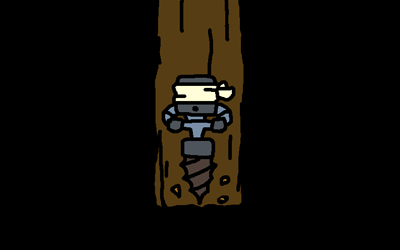
Methodological naturalism is the idea that it’s imprudent to invoke supernatural intervention as an explanation when such miraculous intervention may not be necessary. This is a pillar of mainstream science.
And how do you determine whether supernatural intervention was necessary for some observation?
By assuming, for the sake of argument, that something supernatural did not intervene, and then genuinely attempting to find a sufficient natural (that is, mechanistic) explanation.
The Relentless Robot Thought Experiment
You live on planet Chalybos, and you’ve been taught from birth that the core of the planet is made of an indestructible substance. You begin a mission to search for that indestructible substance.
You’re not the first Chalyban to have this idea. Many people have before begun similar digging adventures.
The first such explorer hit a really tough substance 50 meters down. He was convinced that this was the indestructible core. He wailed on the substance for weeks, but it wouldn’t break. Finally, after failing to dig any deeper, he proclaimed that he had, indeed, found the core.
Later, a different explorer brought a team along with him. After months of working at the stubborn material, they broke through. The material wasn’t indestructible at all; the core had not been reached.
This happened again and again in the history of Chalybos. A team would reach a layer seemingly invulnerable, and proclaim their victory in terms of having discovered the planet’s core. But then a subsequent team would work a little harder and longer and break through what before was claimed to be the core.
And then, the cycle would repeat.
To deal with this, you decide to build a robot that is programmed to dig downward. Even if the robot hits a surface that he has trouble with, he never gives up. He always treats anything he encounters as if he can break through.
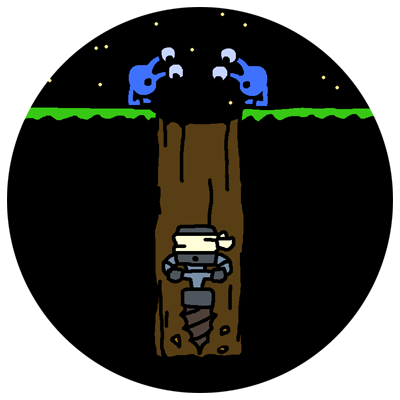
- In some ways, this robot has a weakness: He is stuck in full-throttle dig-mode. He has no perceptions and no decisionmaking faculties. Furthermore, if indeed he does hit the true core one day, he’ll continue digging into it, fruitlessly, forever.
- In other ways, this robot has a strength: He will never give up too soon and falsely proclaim victory, as so many explorers before you had done.
Here are a few opinions of fellow Chalybans:
- Seeing this repetitive pattern of false victories and deeper digs, some conclude that there is no indestructible core at all. There is only an “indestructible core of the gaps,” shrinking every time a team breaks through and digs deeper.
- Eventually, the robot hits a surface that he spends years working against with no success. Some, at this point, say, “We believe the robot has finally arrived at the core — but we must keep him powered, forever, because there is a chance that we’re wrong.”
- Others say, “He has certainly arrived at the core. We should save our energy and shut the robot off. His job is finished.”
- Etc.
No Obvious Answer
Can you see the reasoning behind the skeptics who reject the idea of an indestructible core? Can you see the reasoning behind those who believe the core has been found, but refuse to disconnect the robot? And can you see the reasoning behind those who believe the core has been found, and thus the robot should be disconnected?
I can see the reasoning behind all of these perspectives. None of them are completely meritless nor certainly meritorious.
Methodological naturalism is like the relentless robot. It chews through superstition and baseless supernatural conjecture. Layer after layer, it refuses to quit. To some, this is evidence that there’s no indestructible core at all, that is, there is nothing in existence that does lacks an mechanistic and explanatory underpinning. But I don’t think that necessarily follows. Methodological naturalism is a preference heuristic, not dogma.
I say, “keep the robot going,” while simultaneously putting faith in a God who I believe has interacted with my life in a meaningful, powerful, and efficacious way. This is what Stephen Jay Gould meant by “non-overlapping magisteria.” My beliefs about the core are orthogonal to the activity and revelations of the robot, though they are updated if and when the robot forces it.

“Orthodox” Confusion

“Quiet theology” means practicing theology through philosophical quietism, where philosophy is meant to be more remedial than exciting. As such, it is about treating conjecture like conjecture, being willing to say “Nobody actually knows,” and finding and tackling language problems that have been causing confusion and miscommunication.
The word “orthodox” represents one such confusing language problem.
Note: This is about the semantic difficulties with the word “orthodox,” and not an attack on the Orthodox Church, and not intended as a specific doctrinal indictment.
Five Questions
When determining truth or falsehood of a doctrine, there are roughly 5 big questions we can ask:
- Does it have logically coherent premises and does it proceed from those premises?
- If it has one or more naturalistic premises, are those premises consonant with science?
- Does it have historicity?
- Is or was it popular among acknowledged authorities?
- Is or was it popular within the Church generally?
These are in priority order. For example, its historicity is unimportant if its apparent cogency was based on bad science. Its popularity, even among the respected intellectuals, is unimportant if it can be shown the doctrine does not logically follow from coherent premises.
Notice that we’re trying to determine orthodoxy, or “straight doctrine,” meaning “true doctrine” by figure. When some doctrine fails 3+, the Fathers call it heterodoxy — something different than what ‘we all believe and have been believing.’
A False Dichotomy
But we’ve just put questions of logical validity and — if science is invoked in the claim — scientific consonance above questions of historicity and popularity (that is, tradition).
In other words, it is quite possible that there are various doctrines that are orthodox but heterodox. I’m confident that we can all agree: It’s not impossible for this to be the case for some doctrines.
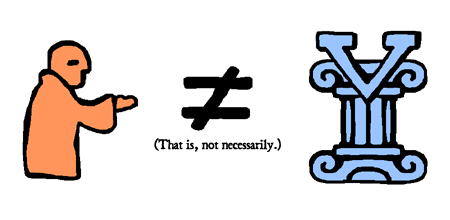
And we know that, as language is mutating, more problematic nomenclature is developing. “Unorthodox,” for example, means “breaking with tradition, often with overtones of creativity and new insight.” Good gravy!
If we were to fix this language problem, we’d add a second qualifying dimension, and perhaps come up with a couple of new terms.
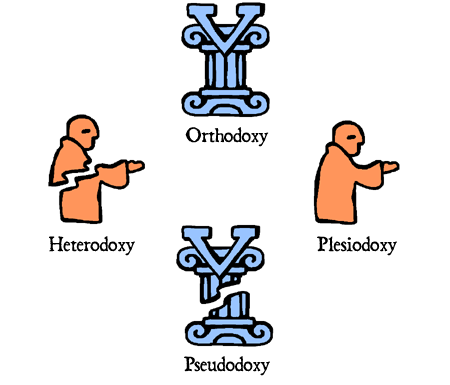 So we’d have “orthodoxy,” true doctrine, as opposed to “pseudodoxy,” false doctrine. And we’d have “heterodoxy,” different than our tradition, as opposed to “plesiodoxy,” near to our tradition.
The problem is that this remedy cannot be administered retroactively. The Church Fathers did indeed consider orthodoxy and heterodoxy dichotomous and single-dimensioned. Tradition was extraordinarily vital for preservation of the faith.
Why was it vital? The Fathers were dealing with three issues: Antiquated philosophy, false science, and logistical challenges.
The Fathers’ Strategy
Here are two uncomfortable facts to admit as Christians:
- Early theologians were not that great at answering question #1.
- Early theologians were really bad at answering question #2.
This isn’t to prop ourselves up as superior giants. It’s to merely admit the fact that when we stand on the shoulders of giants, we are net-taller than giants. We have post-Enlightenment philosophy. We have pivotal scientific discoveries from the 19th, 20th, and 21st centuries that have eliminated mistaken assumptions about how organisms operate. And so on.
Listen. Aristotle was smarter than you or I will ever be. But he also thought air, fire, water, and earth were elements.
We’re not boasting; we just have better tools. And it’s not like we built those tools ourselves. We received them as Christmas presents, for heaven’s sake.
Lacking those better tools, the ingenious progenitors of our theology did their best with what tools they had. Questions #3, #4, and #5 had primacy. “Don’t tolerate teachings other than the ones you received!” was the constant refrain from Fathers like Clement of Rome and Ignatius of Antioch.
But tradition is notoriously dynamic and volatile, especially given the logistical difficulties of the era. So the early Fathers — even up to the Apostles — came up with a way to settle it down.
 By metaphor, the Hat of Approval is the deference given to the hierarchical authority of the Church, especially that which is expressed in Council decisions. We see the roots of “pleisodox/orthodox” conflation take root as a product of this logistical necessity.
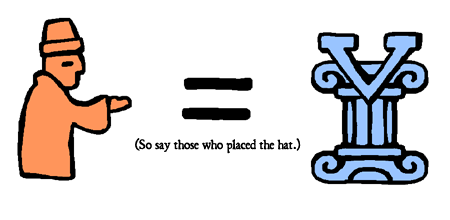
It’s not perfect, but it was almost certainly necessary. And that appears to be the seed that, down the road, blossomed into our current semantic confusion.
Sad Ending
When discussing how to “fix” problematic nomenclature, there are roughly three routes you can take:
- Keep the existing nomenclature, but refine the definition (e.g., “‘Orthodox’ now means traditional doctrine, not true doctrine.”) This has partially happened already, just not “officially.”
- Create new nomenclature completely (like in the four-pronged diagram above).
- Abandon the remedial project and stick with what we have, and wherever it’s going.
All three options will catalyze all sorts of communication problems, but of different kinds.
I apologize for the sad ending. Confident, “100% upside” direction is often preferred by folks in general, even if it’s untrue.
Wars of the Absurdums
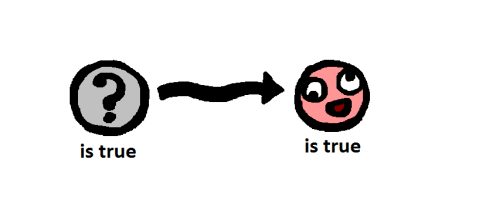
A reductio ad absurdum — I’ll call it “RAA” for short — is when you argue against someone’s claim X by showing that, if X was true, something obviously absurd would also be true.
In other words, as illustrated in the above image, “If the premise was true, the logical implications would be crazy.”
Lisa and George’s Thermometer Collection
Lisa and George are watching it rain.
“Gross, rainy weather lately,” says Lisa. “How cold do you think it is out there?” asks Lisa.
“Maybe 25, 30,” replies George, speaking Fahrenheit.
“What!?” Lisa exclaims. “If it were that cold, it’d be snowing, and we’d be hallucinating! And that’s absurd!”
Pretty straightforward, right? It’s absurd that they’re both hallucinating the rain, and so it mustn’t be 25-30 degrees; 32 is the freezing point in Fahrenheit.
“Alright, let’s check,” says George. They walk out to the back porch and look at the thermometer outside. “See?”
Just as George guessed, it was 29 degrees outside.
“The thermometer must be broken,” said Lisa. “Let’s check the one we have on the front porch.” But, sure enough, the front porch thermometer said 29, too.
Same with the thermometer just outside the kitchen window.
“They can’t all be broken in exactly the same way,” says George. “That’d be absurd.”
RAA-Breakers
It turns out that, from the outset, Lisa was unaware of the fact that temperature can vary in different layers of atmosphere. If it’s warmer above the surface, rainfall may not have time to freeze before hitting the ground, even though it’s passing through a sub-freezing layer.
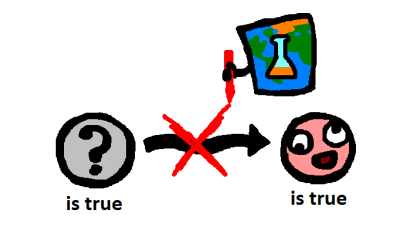
In other words, learning more about how the world works and doesn’t work can make the difference between some RAA being thought false versus true.
Furthermore, sometimes RAAs are just “non sequiturs,” which means that they don’t logically follow, e.g., “If it was 25-30 degrees outside, all morality would be invalid.”
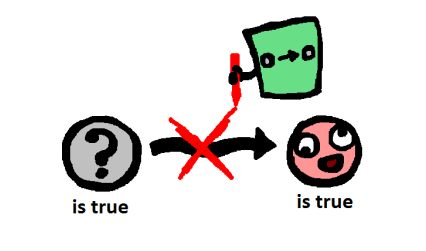
That’s an obvious one, but non sequiturs are often very subtle. Recognizing non sequiturs where they exist can also make the difference between some RAA being thought false versus true. My own record is spotted with many infractions for criminally using non sequitur RAAs! But I’ve done my share of repentance. (And this is my penance.)
Earlier, I wrote about a specific kind of non sequitur — where you think the world is “too rocked” by a world-rocking revelation — and called it “Kochab’s Error.” Kochab’s Error is often used in an attempt to argue ad absurdum.
Little Sermon Sunday: Polycarp to the Prosperity-Gospelites

Okay, okay, we’re actually going to be reading excerpts from Polycarp’s letter to the Philippians. But his words reach through death and time and culture, giving us advice today about avoiding the [g]ospel of “money, prestige, image, security,” and how [G]ospel-followers ought react to this [g]ospel and the followers thereof.
Polycarp writes:
‘But the love of money is the beginning of all troubles.’ Knowing, therefore, that ‘we brought nothing into the world, nor can we take anything out,’ let us arm ourselves with ‘the weapons of righteousness,’ and let us first teach ourselves to follow the commandment of the Lord.
…
I have been deeply grieved for Valens, who once was an elder among you, because he so fails to understand the office that was entrusted to him. I warn you, therefore: avoid love of money, and be pure and truthful. ‘Avoid every kind of evil.’ But how can a man who is unable to control himself in these matters preach self-control to someone else? If a man does not avoid love of money, he will be polluted by idolatry, and will be judged as [those] who are ignorant of the Lord’s judgment.
…
Therefore, brothers, I am deeply grieved for [Valens] and for his wife; may the Lord grant them true repentance. You, therefore, for your part must be reasonable in this matter, and do not regard such people as enemies, but as sick and straying members, restore them, in order that you may save your body in its entirety. For by doing this you build up one another.
For I am convinced that you are all well trained in the sacred Scriptures and that nothing is hidden from you (something not granted to me). Only, as it is said in these Scriptures, ‘be angry but do not sin,’ and ‘do not let the sun set on your anger.’ Blessed is the one who remembers this, which I believe to be the case with you.
The Fourfaced Writ

Is the imperative, “Do what the Bible says,” simple?
The following thought experiment shows why — even though the correct answer is uncomfortable — the correct answer is, “No.”
The Fourfaced Writ
There is a religion called “Writianity” that reveres the Fourfaced Writ, an ancient collection of writings, as divinely inspired.
Alongside various accounts of historical events, there are the following 4 moral guidelines given, called the “Faces of Propriety,” from where the collection receives the name “Fourfaced.”
- If a powerful man is convicted of murder, he must be killed, since he could escape imprisonment. Other murderers, however, may be safely imprisoned for many years.
- Do not let any foreigners from the West into your home. Always welcome, however, foreigners from the East.
- Any woman who braids her hair must be chastised for immodesty.
- Dictates in this writ are subject to what is profitable and constructive in service of charity and wisdom, which must co-reign as the goals supreme. You are not under the tutorship or guardianship of the letter.
Over many years since the Fourfaced Writ was first written, however, history takes various turns:
- Prisons are developed that can easily hold powerful men.
- Regional politics change such that Westerners are now friends and Easterners are now enemies.
- Braiding is no longer considered culturally immodest, and is universally considered innocuous, even boring.
And thus, Face #4, in the eyes of many, is becoming more and more relevant.
So, here’s the question: Who is the most sincere, Writ-devoted Writian, who follows the Fourfaced Writ “most”?
- The one who insists that Faces 1-3 be followed 100%?
- Or the one who follows Face 4 and thereby relaxes Faces 1-3?
I hope you’ll agree that the answer is not straightforward.
The Characters
Given that the answer is not straightforward, we can watch this ambiguity catalyze the emergence of four archetypical “characters” in Writian society.
- Let’s call that first Writian the Conservative. She is hesitant to admit that Faces 1-3, which were divinely-ordained, have become outdated. She is afraid that if we’re not careful, we might throw away a Face while it’s still important.
–
She’s further worried that we might get in the habit of discarding rules and morality entirely. She agrees with each of Faces 1-4, but thinks, for whatever reason, that Faces 1-3 are still profitable and constructive (and do not thus qualify for relaxation per Face 4).
– - Let’s call that second Writian the Progressive. He recognizes that Faces 1-3 are no longer profitable and constructive, and may in fact be deleterious. He considers himself ready and willing, through reason and observation, to subject Faces 1-3 to scrutiny per Face 4. He recognizes the spirit behind the first 3 Faces, and seeks to preserve them (but again, only insofar as it is useful, per Face 4).
–
And so, he (1) holds back on grave retribution unless necessary to protect society, he (2) is extra wary of those proximal to enemies and extra trusting to those proximal to friends, and he (3) values modesty of dress (and may even extend that more general guideline across genders).
– - There is another who claims to be Writian: the Fundamentalist. He does not care about whether Faces 1-3 are still valid per Face 4. He sees all the Faces written, and thus follows them without question. Though the words in Face 4 would seem to qualify Faces 1-3, he sees qualification as compromise.
–
Furthermore, he draws a measure of validation, even zealous duty, from standing up against those who would ever consider the relaxation of Faces 1-3 per Face 4.
– - There is a final character who claims to be Writian: the Antinomian. The Antinomian Writian thrives on ambiguity and incoherence. Anything goes! Both the letter and the spirit of the law can be ignored arbitrarily, as it suits her whims. She calls herself a Writian because she occasionally chooses to look at the Writ for insight, or find ways to lend force to her own opinions by manipulating its words.
Here are some statements we can make about the characters:
- The Conservative is not a Fundamentalist.
- The Progressive is not an Antinomian.
- The Conservative and the Progressive can have continuing and productive Writian conversations.
- You generally cannot have productive Writian conversations with the Fundamentalist and the Antinomian.
- The Conservative and Progressive are both rooted in Writian teaching, which is nonetheless complicated by the 4th Face.
- The Fundamentalist and the Antinomian are not rooted in Writian teaching, because the former ignores the 4th Face completely, and the latter ignores the heart of the first 3 Faces completely.
Our Christian Writ
In what ways is The Fourfaced Writ analogous to the Bible? Paul supplies the answer.
Paul deals with morality in two major ways:
- He urges a self-sacrificial “self-cleansing,” and as such, has many moral guidelines that he directs to different churches and ministries. For example, Paul forbids women to braid their hair or wear jewelry, calling them immodest. (2 Timothy 2:9-10)
– - But he also relaxes rules when the full force thereof is counterproductive. He frames the “law of freedom” as doing that which is beneficial and constructive, founded on the “royal law” of doing to others as you’d have them do to you.
–
“So that the law was our tutor until Christ came, that we might be justified by faith. But now that faith has come, we are no longer under a tutor,” Paul says in Galatians 3:24-25, rebuking those who wished to ferry adherence to the Old Law into New Covenant life.
–
“All things are lawful, but not all things are beneficial. All things are lawful, but not all things are constructive,” he says in 1 Corinthians 10:23, after a lesson about how even a mandated law for Jews and Gentiles alike from the Council of Jerusalem can and should be relaxed in service of consequence (even though the Council’s decree is part of New Scripture!; Acts 15).
In other words, it’s a complicated moral discussion. Our conservative brethren recognize the need to “break progressive” when appropriate. For example, the conservative-leaning ApologeticsPress.org says of Paul’s braid-distaste:
“Summing up the meaning of these two passages [1 Timothy 2:9-10 & 1 Peter 3:3-4], we see that Paul and Peter were not forbidding a woman from wearing a golden wedding band or having her hair modestly braided. They were, however, instructing the women to concentrate on good works and a right attitude instead of trying to impress others with immodest clothes that were inappropriate or excessively gaudy.”
There are legitimate viewpoints toward rule-following and legitimate viewpoints toward consequence-orientation on almost every moral issue.
Progressives and conservatives alike should recognize that maneuvers like the above are relaxations of face-value Scripture, and together admit, “That’s sometimes appropriate. Now, let’s discuss where and when that’s appropriate.”

Up a Tree

The following story is about a man who’s been living in trees. But it’s really about something more psychological, that has a grave impact on serious, truth-seeking discussions. Can you figure out what it is, before the reveal?
Above is a video of environmental activist Josh Eng climbing into his home in the treetops. When I first heard this story last month, he’d been up in the trees with his friends for nearly 10 weeks.
He and his friends are living in these trees in order to stall or prevent logging projects on a small grove recently purchased by a private logging company.
But there’s a twist.
The manner in which this logging would take place is by a strategy called “variable retention.” Variable retention projects are designed by forestry ecologists to harvest selectively, in order to simulate natural events like wildfires — which we stop every year in Oregon, but which have the beneficial consequence of promoting diverse and vibrant forest ecosystems. This project in specific was designed by university professors with “long track record[s] in conservation.”
Variable retention is annoying for logging companies. It’s “more laborious, tedious, time-consuming, and expensive than clear-cutting.” But it’s a workable solution in places where harvesting and conservation often butt heads.
When asked about the fact that this environmentally-friendly strategy would be employed at the new purchase, Eng replied, “It would be a real heartbreaking thing to see it go the way of a variable retention harvest,” his words soaked with derision.
When I heard this story, I had a disheartening realization: This man and his friends have been living up in the treetops, cold and bored, for over 2 months. It doesn’t matter if variable retention is ecologically friendly, but let’s assume it is. How could they possibly admit that their cause was needless?
They can’t.
This story powerfully illustrates how loss-aversion — where “having been mistaken all along” is an extraordinarily potent sort of loss — can build not just a sandbag, but a bastion against competing argumentation.
The further up the tree you go, and the more effort you expend, the worse the “friction” becomes. By “friction” I mean “memetic friction” — the tendency to get rooted to local maxima (“decent-looking ideas that may not be the best ideas”) because you don’t have enough mutative power to leave.
You know the saying. “A bird in the hand is better than two in the bush.” You also know the refrain that begins so many of our contemplations: “I’d sure be an idiot if…”
That psychological quirk of loss-aversion — life-and-death useful long ago when catching birds was a matter of survival — affects even the learned, intelligent, and confident among thinkers… even the most renowned.
–
The original story from OPB Radio, by Amelia Templeton and Tony Schick. This post uses their images and video.
Wikipedia: “Variable Retention.“
Excerpts from Origen, De Principiis, Book IV
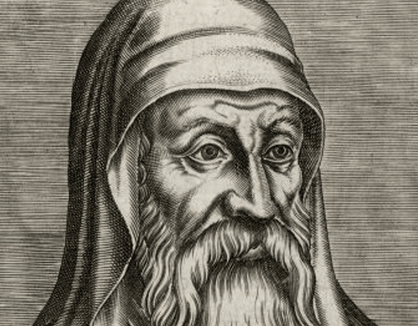
Origen was a great thinker but was, in many ways, a lot like other early Church fathers. He offered theology based on logical derivations from Scripture one minute, but brazen theological conjecture the next minute, and Neo-Platonic syncretism the minute after that. We don’t have to blindly agree with every little thing an early Church father says, especially when it doesn’t make a lick of sense.
But many times what they say makes more than a lick of sense. Many times, it’s oozing with reason and wisdom, and can provide us with some quiet sanity, even 1800 years later.
Such is the case with Origen’s “On First Principles, Book IV,” written in the early 3rd century.
Some Christians would like to claim that they consistently take the Bible literally. Origen shows why this is plainly impossible.
Those Christians often, then, respond with the question, “Then how can we easily divide the literal from the figurative?” Origen’s response: “You can’t, easily. But here are some tips.”
Excerpts, slightly reordered, from Origen’s “De Principiis, Book IV”:
Having spoken thus briefly on the subject of the divine inspiration of the holy Scriptures, it is necessary to proceed to the [consideration of the] manner in which they are to be read and understood, seeing numerous errors have been committed in consequence of the method in which the holy documents ought to be examined; not having been discovered by the multitude.
For [those that] have not believed on our Saviour, thinking that they are following the language of the prophecies respecting Him, and not perceiving in a manner palpable to their senses that He had proclaimed liberty to the captives, nor that He had built up what they truly consider the city of God, nor cut off “the chariots of Ephraim, and the horse from Jerusalem,” nor eaten butter and honey, and, before knowing or preferring the evil, had selected the good.
And thinking, moreover, that it was prophesied that the wolf the fourfooted animal was to feed with the lamb, and the leopard to lie down with the kid, and the calf and bull and lion to feed together, being led by a little child, and that the ox and bear were to pasture together, their young ones growing up together, and that the lion was to eat straw like the ox: seeing none of these things visibly accomplished during the advent of Him who is believed by us to be Christ, they did not accept our Lord Jesus.
…
Nor even [does the Old Testament] wholly convey what is agreeable to reason. For who that has understanding will suppose that the first, and second, and third day, and the evening and the morning, existed without a sun, and moon, and stars? and that the first day was, as it were, also without a sky?
And who is so foolish as to suppose that God planted a paradise in Eden after the manner of a husbandman…? … And if God is said to walk in the paradise in the evening, and Adam to hide himself under a tree, I do not suppose that anyone doubts that these things figuratively indicate certain mysteries, the history having taken place in appearance, and not literally.
Cain also, when going forth from the presence of God, certainly appears to thoughtful men as likely to lead the reader to inquire what is the presence of God, and what is the meaning of going out from Him. And what need is there to say more, since those who are not altogether blind can collect countless instances of a similar kind recorded as having occurred, but which did not literally take place?
…
And what is said in many places, and especially in Isaiah, of Nebuchadnezzar, cannot be explained [literally] of that individual. For the man Nebuchadnezzar neither fell from heaven, nor was he the morning star, nor did he arise upon the earth in the morning.
…
And it is impossible to take [literally, the statement] in the Gospel about the “offending” of the right eye. For, to grant the possibility of one being “offended” by the sense of sight, how, when there are two eyes that see, should the blame be laid upon the right eye? And who is there that, condemning himself for having looked upon a woman to lust after her, would rationally transfer the blame to the right eye alone, and throw it away?
…
All these statements have been made by us, in order to show that the design of that divine power which gave us the sacred Scriptures is, that we should not receive what is presented by the letter alone (such things being sometimes not true in their literal acceptation, but absurd and impossible), but that certain things have been introduced into the actual history and into the legislation that are useful in their literal sense.
But that no one may suppose that we assert respecting the whole that no history is real because a certain one is not; and that no law is to be literally observed, because a certain one, [understood] according to the letter, is absurd or impossible; or that the statements regarding the Saviour are not true in a manner perceptible to the senses; or that no commandment and precept of His ought to be obeyed; we have to answer that, with regard to certain things, it is perfectly clear to us that the historical account is true… And therefore the exact reader must, in obedience to the Saviour’s injunction to “search the Scriptures,” carefully ascertain in how far the literal meaning is true, and in how far impossible; and so far as he can, trace out, by means of similar statements, the meaning everywhere scattered through Scripture of that which cannot be understood in a literal signification.
…
For, with respect to holy Scripture, our opinion is that the whole of it has a “spiritual,” but not the whole a “bodily” meaning, because the bodily meaning is in many places proved to be impossible. And therefore great attention must be bestowed by the cautious reader on the divine books, as being divine writings.
…
Let us notice, then, whether the apparent and superficial and obvious meaning of Scripture does not resemble a field filled with plants of every kind, while the things lying in it, and not visible to all, but buried, as it were, under the plants that are seen, are the hidden treasures of wisdom and knowledge; which the Spirit through Isaiah calls dark and invisible and concealed, God alone being able to break the brazen gates that conceal them, and to burst the iron bars that are upon the gates.
The Angelic Ladder

Oooh, sounds spooky, right? It’s actually just a way, brought to us by mid-20th century philosopher R. M. Hare, to understand the many-layered nature of moral discussions, even under consequentialism.
And this understanding is vitally useful for Christianity; not just for moral decisionmaking, but also for various questions of theology and theodicy.
The “Rule” Snag
Consequentialism is roughly the doctrine that moral/ethical* decisionmaking is “mostly about” seeking goals or interests, rather than being “mostly about” following rules. Upon hearing this, some recoil and shout, “If it’s mostly about seeking goals or interests, then rules don’t matter at all!” They combine this first premise with the knowledge that moral discussions are very “rule-y,” finally concluding that moral decisionmaking must not be “mostly about” seeking goals or interests.
* (Morality and ethics are the same thing. Those who claim otherwise cannot agree on what the differences ought to be.)
But that first premise is false. Moral decisionmaking being “mostly about” seeking goals or interests does not mean that “rules don’t matter at all.” The Angelic Ladder is a great way to illustrate why that is.
Meet the Two Characters

The first character is the “Archangel.” It’s just an illustrative figure. The Archangel is totally aware and totally wise. By “totally aware,” I mean that she knows everything there is to know. By “totally wise,” I mean that she can use that knowledge — how the universe works, at every infinitesimal moment, from the distant past to the distant future, from the largest galaxy to the smallest subparticle — to make perfect “forecasting” decisions, like a cosmic Al Roker, in service of her interests.
Furthermore, because the Archangel is fully aware and fully wise, she is never bound by methodological rules. In other words, she needs no “cheat sheet” to augment her decisionmaking abilities; her decisionmaking abilities are already perfect. As such, if somebody handed her a guidebook, she would either immediately reject it, or it would be redundant to what she already knows.

The second character is the “Prole.” The Prole is completely unaware and completely stupid. By “completely unaware,” I mean that he has no idea what’s currently going on. By “completely stupid,” I mean that he has no idea how the universe works, and so even if he did know what was going in, he cannot fathom any of the prospective (“future-looking”) consequences of his actions.
Because he is so senseless and dim, he is always bound by methodological rules. He needs a “cheat sheet” to make any headway toward his interests.
Note: We cannot turn our Prole into what A. I. engineers call “an expert system” by bombarding him with innumerable rules in an exhaustive, astronomically large guidebook. He’s a blockhead, remember. His “cheat sheet” needs to fit on a note card.
Different Interests
Does this mean that all Archangels make the same decisions, and all Proles follow the same guidebook?
No way.

That’s because different beings have different interests. There’s one for every color of the rainbow! The Archangel in the lower-right wants to optimize “maximum amount of ice-cream” and “minimum amount of planets.” The Prole in the upper-right wants to be the best fiddle player in the galaxy and to live as long as possible, and to violently shove his enemies at every opportunity.
These examples are silly, but it doesn’t really matter what these interests are, exactly. All that matters is that each being can have his or her own interest set, and within that interest set, there may be interests that are circumstantially incommensurable (in other words, there may be moments where total interest satisfaction is logically impossible, no matter how powerful or wise the decisionmaker may be).
Let’s get rid of that variable for now, and assume we’re dealing with an Archangel and Prole that have a perfect alignment of interests.
The Ladder
We can place these two characters on a ladder-like scale — Archangel on top, Prole down below.
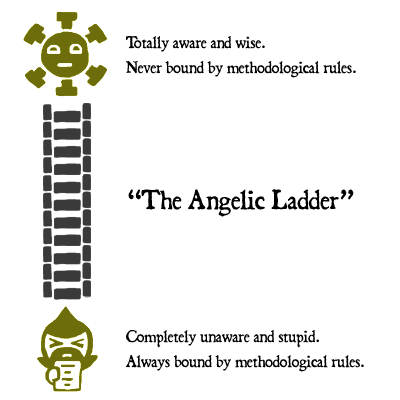
Archangel and Prole, after all, are two extremes. Most of us are just pretty unaware and quite stupid, but not completely. And so our proper place on the Ladder might be slightly higher than our hopeless Prole.

Look what happens! We have a little flag of slight wisdom atop our dunce caps. We have one eye open. And the rule list to which we’re fully bound is a little shorter.
In other words, add a dash of awareness and wisdom, and the legislation becomes a little less strict and prescriptive.
Wrong Rungs
Now, every being with interests has a “proper place” along the ladder, as a function of his or her actual wisdom and awareness. But it’s certainly possible that a being will think he is wiser and/or more aware than he really is, and violate rules to which he should adhere. The cost of that violation is a failure to optimally seek his interests.
It’s also possible that a being will think she is more stupid and/or less aware than she really is, and conform to a rule she should violate. The cost of that conformity is a failure to optimally seek her interests. See the pattern here?
It also may be that a being may fail to recognize another being’s proper place along the ladder. A parent might think their child more bright than she actually is, and allow her to bend rules she shouldn’t. Another parent might think their child less bright than he really is, and subject him to rules he should be free to bend when he finds it justified.
Ladder-Climbing 101 for Individuals and Groups
In none of this, however, should it be implied that our place on the Ladder is fixed and rigid. Our proper place, as I wrote above, is a function of our actual wisdom and awareness. Refine and train your predictive skills, improve your critical thinking, and research and learn how things — both simple and abstract — work, and you’ll probably increase in wisdom and awareness, climbing the Ladder thereby.
As always, we can group-up a large number of individuals and talk about the interests, decisions, and Ladder position of that aggregate.
For example, an ancient oligarchic council may recognize that the citizens of their stone city, in aggregate, are generally bad at making decisions in service of that aggregate’s higher-order (roughly, “big picture”) interests, and may warrant a healthy dose of laws, regulation, and micromanagement. Centuries later, after dramatic technological, scientific, and philosophical development, and building robust educational systems, the new council may find it fitting to relax or revoke various laws and regulations.
And this isn’t to say those laws and regulations were always bad; they might have been helpful when the aggregate was dull, but only to a point — like a gravity well at some specific Ladder rung, helping anything below, and burdening anything above.
The Inscrutable Archangel
Finally, it’s important to understand that even if the Archangel and near-Prole share the same interest set (“color”), the Archangel will plausibly not only violate the rules to which the near-Proles are called to submit, but may make all sorts of “bad now” decisions in investment service of a big-picture payoff down the road (“bad” in terms of the shared interest set). The near-Prole may be completely perplexed as to how those decisions could possibly be justified.
I feed my dog twice a day. I also throw him scraps from time to time, and let him eat treats from friends’ hands. But while on a walk, if he sees a treat on the ground, I grip the leash and prevent him from gobbling it up, because I have a higher knowledge that strange food can be dangerous. He probably thinks I’m just silly sometimes, with my odd restrictions, and shrugs it off.
We humans are pretty creative, though, and so the over-eager near-Prole human might rush to act “above his paygrade,” using his pathetic brain to imagine up and and announce explanations that could have nothing whatsoever to do with the real chain of prospective events that will, eventually, justify those “troughs.” And, indeed, his embarrassing attempts will probably be crude, ill-conceived, and even horrific.
A more “at paygrade” approach, if he sincerely believes the Archangel is on “his side” in terms of shared big-picture interests, is to practice a hope in a down-the-road justification, offer abstract possibilities humbly and carefully, and hasten to admit his ignorance.
Less Eliphaz, Zophar, Bildad, Dr. Pangloss, and Pat Robertson. More Elihu and post-storm Job.
Rules Rule… Usually
By now, I think you’ll agree that when we take the “epistemological vector” (the measure of knowledge) into account, there’s all sorts of room for rules under consequentialism, especially given the fact that we know that we’re terrible at understanding the full breadth of how the universe works and the full consequential fallout of each action. We can’t even reliably predict the weather more than a few days out — a cosmic Al Roker, we’re not.
And thus, even if we accept that morality proceeds consequentially, we can still say, “Follow the rules… unless you have a really, really good reason not to.”
Kochab’s Error

Kochab was a cartman who made his living ferrying travelers back and forth between Rome and Constantinople. Each trip took two weeks, but this was much faster than the road by foot, and passengers were eager to pay for his services.
Kochab found the life of a conveyor, while lucrative, rather mundane in and of itself. And so, even though he was an otherwise simple man, Kochab would endeavor to visit and listen to learned people, in both great cities, in order to spark his own imagination and spur contemplation, occupying his thoughts during his back-and-forth journeys.
One day, he attended a lesson by a famous astronomer in Constantinople named Al-Udhi.
“We imagine the Earth as being great in size, and the center of the universe,” said Al-Udhi. “When we look at the starry sky, the cosmos appears as a dome that is not so far away.”

“But these are mere appearances,” explained Al-Udhi. “Through careful observation and mathematical calculation, we have discovered that the earth is not the center of the universe; and the stars are very, very far away indeed; and the size of the earth is very tiny compared to the great size of the cosmos.”
This was startling to Kochab. Al-Udhi was right: Kochab did imagine the earth to be great in size, and the center of the universe. Before, the earth felt very, very large indeed to him. In the eye of his mind, the earth dominated the entirety of the cosmos, filling it up with bright blue and green; but now the artwork of his imagination was full of darkness, littered with stars, with a lonely, miniscule earth in one corner.
To Kochab, it felt as if the earth had shrunk.

So convincing to Kochab was this feeling that he fell into despair, cursing Al-Udhi for spreading this news. “Who now will need my services?” Kochab lamented. “The world is so small, and thus Rome and Constantinople so close together, that one might as well walk!”
–
A realization about the world, and how it is, or how it works, may prompt a significant paradigm shift in one’s conceptions. When such a jostling happens, it’s human propensity, upon being spurred to re-evaluate, to go “too far.” We might not be as silly as Kochab, but humans conclude non-sequitur conclusions all the time, and especially when their worlds are rocked like Kochab’s.
Furthermore, if that “too far” conclusion is an absurdum, we’ll be extra-likely to reject the paradigm shift at the outset, even though that conclusion is “too far” (a non-sequitur), and that paradigm shift is worth adopting!
In subsequent posts, I’ll talk about difficult conclusions we get “for free” from benign premises. Difficult conclusions often “rock worlds” and prompt non-sequitur absurdums. I’ll be referring to Kochab’s Error in those upcoming posts and linking back here. Keep an eye out!
Follow-up: Wars of the Absurdums
Little Sermon Sunday: Ignatius to the Ephesians

Ignatius of Antioch, in the custody of Roman soldiers, along the long road to Rome to be executed, sent a letter to the church in Ephesus:
You are stones of a temple, prepared beforehand for the building of God the Father, hoisted up to the heights by the crane of Jesus Christ, which is the cross, using as a rope the Holy Spirit; your faith is what lifts you up, and love is the way that leads up to God.
…
Pray continually for the rest of mankind as well, that they may find God, for there is in them hope for repentance. Therefore allow them to be instructed by you, at least by your deeds. In response to their anger, be gentle; in response to their boasts, be humble; in response to their slander, offer prayers; in response to their errors, be steadfast in the faith; in response to their cruelty, be gentle; do not be eager to retaliate against them. Let us show ourselves to be their brothers by our forbearance, and let us be eager to be imitators of the Lord.
…
There is nothing better than peace, by which all warfare among those in heaven and those on earth is abolished. None of these things escapes your notice, if you have perfect faith and love toward Jesus Christ. For these are the beginning and end of life: faith is the beginning, and love is the end, and the two, when they exist in unity, are God. Everything else that contributes to excellence follows from them. No one professing faith is sinful, nor is anyone possessing love hateful. “The tree is known by its fruit”; thus those who profess to be Christ’s will be recognized by their actions. For the Work is not a matter of what one promises now, but of persevering to the end in the power of faith.
It is better to be silent and real, than to talk and not be real. It is good to teach, if one does what one says. … Nothing is hidden from the Lord; even our secrets are close to him. Therefore let us do everything with the knowledge that he dwells in us, order that we may be his temples.
…
Now the virginity of Mary and her giving birth were hidden from the ruler of this age, as was also the death of the Lord — three mysteries to be loudly proclaimed, yet which were accomplished in the silence of God. How, then, were they revealed to the ages? A star shone forth in heaven brighter than all the stars; its light was indescribable and its strangeness caused amazement. All the rest of the constellations, together with the sun and moon, formed a chorus around the star, yet the star itself far outshone them all, and there was perplexity about the origin of this strange phenomenon which was so unlike the others.
Consequently all magic and every kind of spell were dissolved, the ignorance so characteristic of wickedness vanished, and the ancient kingdom was abolished, when God appeared in human form to bring the newness of eternal life; and what had been prepared by God began to take effect. As a result, all things were thrown into ferment, because the abolition of death was being carried out.
Popular Posts


Latest: stan rock
How “Midstream Bivalence” Leads to Reckless Philosophy

In philosophy, we all love the idea of discovering a new powerful argument, or finding a formidable refutation, or figuring out a beautiful new articulation, or validating our preconceived beliefs. We crave something confident & conclusive. And so any bug that both provides that confidence and slips past even very intelligent people is going to […]
Are Actual Loops of Objects Impossible?

Horace, Irene, and Julia are discussing what kinds of numbers and arrangements of objects are actually possible. Horace comes up with a thought experiment with the following premise: It’s clear to all three friends that this situation is logically impossible. This is because even though each premise of the setup is conceivable individually, their combination […]
A Stupid Electoral System for Goofs

(Or, “How to Keep a Republic.”)
Potentially Bad Philosophy

Quietude might be described as as figuring out under what odd conditions it might be good to question some of our most trustworthy guides in philosophy and theology. This is dangerous stuff, because we depend on those guides. We rely on their investment of (life)time, their investment of contentious discourse, and we take advantage of […]
All Metaethics in Brief

The time has now come to make a “clip show” post on metaethics. Brazenly I assert that all metaethics can be captured in brief.
The Ontological Argument’s Trojan Horse

The Ontological Argument for God has always been controversial. Some believers think it works. Other believers say it does not. I am in the latter group. It’s good to explore when and if arguments for God are dysfunctional. I am indeed asserting that the Ontological Argument does not work. It’s tricky, though, because OA’s power is in […]
Please Stop Saying Free Will Contradicts Universal Reconciliation

There’s a meme that universal reconciliation (wherein the Gehenna of Judgment doesn’t last forever) doesn’t work with free will (or agency, or dignity, or cooperation, or what have you). We’ve discussed this before on this blog, but that material had some distractions that I hope we can avoid this time around. The point this time […]
But He is Also Just: The Simplicity & Complexity of Biblical Justice

The Bible talks about justice a lot. In the abstract, Biblical justice is really straightforward. But the manner in which Biblical justice plays out is complicated. That’s because justice…
Determinism Doesn’t Mean a Micromanaging God

“Durdle Dwarves” is a simulation where little “Dwarf” pixels dig-through and build rock-like structures. They do this according to a set of 20 rules. A rule tests a Dwarf’s vicinity and provides a response. (For example, if a Dwarf notices a drop-off to his left, he’ll build a new piece of “bridge”; that’s 1 rule […]
A Musical Guide to How Morality Works

Until confronted with moral dilemmas, right decisionmaking — after we untangle our interests — seems pretty straightforward. Like this guy. One happy fellow, playing his guitar: And when we’re no longer “in dilemma,” we can forget about the complexity of morality, and revert to this “straightforward” / “common sense” / “plain to see” / “easy” falsity. But […]
 stan rock
Recent Comments